For most driveway, pathway, and paving projects, you use both. Road base for the structural sub-base layer, crusher dust as the fine bedding layer on top. They're not alternatives; they're partners. Here's when each one does the job alone, and when you need them together.
Crusher Dust vs Road Base: Quick Comparison
Road Base (Crushed Rock) | ||
|---|---|---|
Particle size | Fine (under 5mm) | Coarse (up to 20mm) |
Texture | Sandy, compacts tightly | Gravelly, angular aggregate |
Load-bearing | Moderate — not structural | High — structural sub-base |
Layer position | Top (bedding layer) | Bottom (sub-base) |
Best for | Pavers, turf base, pathways | Driveways, structural base |
Compacts to | Very firm, smooth surface | Very firm, stable base |
Drainage | Semi-permeable | Moderate- limited |
Cost | Moderate | Moderate |
What is Road Base (Crushed Rock)?
Road base (Crushed Rock) is a non-decorative, functional material used as a compacted base under other finishes laid over the top. It consists of materials like, crushed gravel, which is compacted to form hard surfaces. The composition includes blue or grey rock fragments around 20mm in size with smaller particles, down to "fines" mixed in. This mixture ensures a solid compacted surface.
Applications:
- Driveways
- Parking lots
- Garden pathways
- Building pads and bases
- Hardstand areas
What is Crusher Dust?
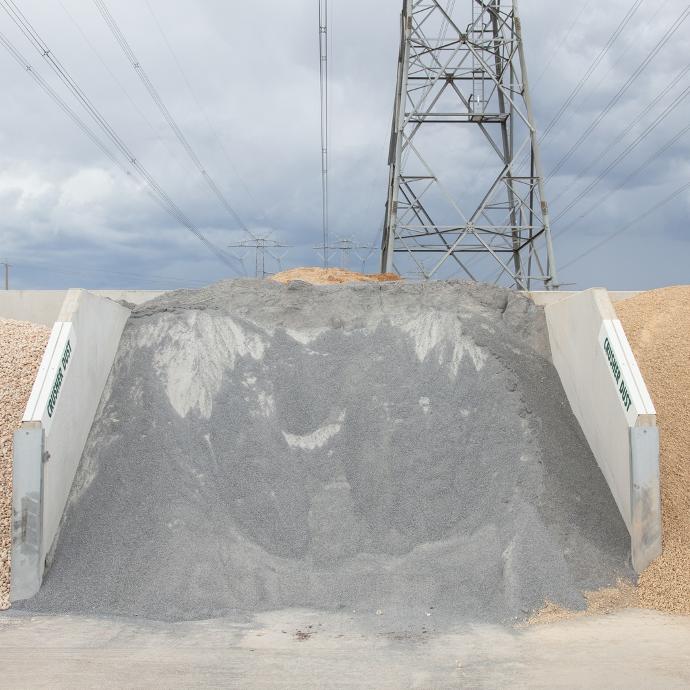
Crusher dust is a fine, grey material made from crushed rock particles, typically 5mm and under. It's produced as a by product of quarry crushing operations and is one of the most versatile landscaping materials available.
Its fine particle size means it compacts tightly and creates a smooth, firm surface. It is ideal as a bedding layer under pavers, turf, or pathway surfaces.
Crusher dust is best for:
- Bedding layer under pavers (50–75mm), washed concrete sand is another popular option.
- Base layer under synthetic turf (50mm)
- Compacted pathway surface
- Filling and levelling
What Is Road Base?
Road base (also called road base aggregate or crushed rock) is a coarser, mixed aggregate containing particles up to 20mm in size. It typically includes a mixture of sand, gravel, and crushed rock fines, which compact together to form a very firm, load-bearing layer.
Road base is the standard sub-base material for driveways, roads, and any application where the surface needs to carry vehicle loads.
Road base is best for:
- Driveway sub-base (100–150mm compacted)
- Structural base under heavy loads
- Base layer for pavers on vehicle-accessible areas
- Compacted base for sheds and buildings
Which Projects Need Both
Most paving and pathway projects use both materials in layers:
Typical paving layering (from ground up):
1. Excavated and prepared subgrade (natural ground)
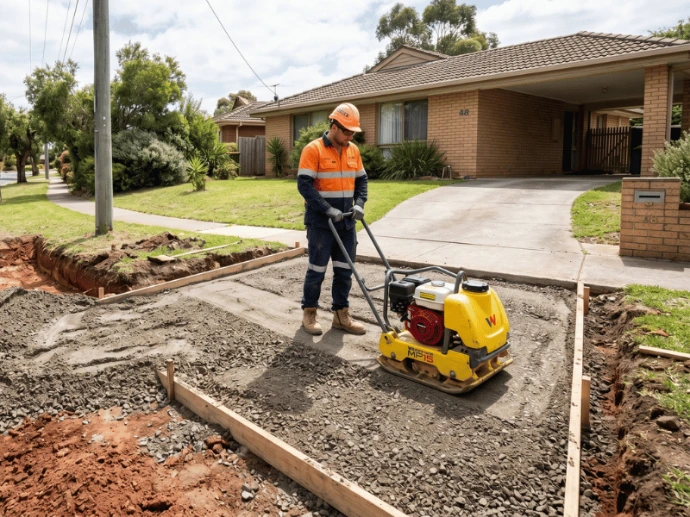
2. Road base sub-base — 100–150mm, compacted in 75mm lifts
3. Crusher dust bedding layer — 50–75mm, compacted and levelled
4. Pavers / surface material
Typical synthetic turf installation:
1. Excavated and prepared subgrade
2. Road base sub-base — 50–100mm, compacted
3. Crusher dust bedding layer — 50mm, compacted
4. Synthetic turf
Crusher dust only (pathway):
For a lightly trafficked footpath, compacted crusher dust alone can work as both base and surface. Not suitable for vehicle access.
Road base only (back-of-shed, storage area):
If you just need a firm, stable surface for storage and light foot traffic, compacted road base alone can work, however it's not as smooth underfoot as crusher dust and is harder to work with.
Crusher Dust vs Road Base for Driveways
For a driveway that needs to carry vehicle loads:
- Road base is essential for the sub-base as it provides the structural strength. Minimum 100mm compacted depth, deeper for heavy vehicles.
- Crusher dust can be used as the top layer if you're laying pavers over it, but not as the only base for a vehicle-trafficked driveway as it doesn't have sufficient structural strength on its own.
- If you want a crusher dust surface driveway (loose, no pavers), it can work for light vehicle use but will need regular re-compaction as it shifts over time.
Order Crusher Dust and Road Base at Daisy's
Daisy's stocks both crusher dust and road base at all locations across Melbourne and Geelong. Available in bulk cubic metres for large projects or smaller quantities to be picked up or delivered.
Frequently Asked Questions
No. Crusher dust is a fine material (under 5mm particle size) used as a bedding layer. Road base is a coarser aggregate (up to 20mm) used as a structural sub-base. They look similar but serve different purposes at different layers of a project.
For light-use pathways and garden applications, crusher dust on its own works well. For driveways, vehicle-trafficked areas, or any structural application, road base is required for the sub-base. Using crusher dust instead of road base under a driveway risks surface failure under load.
Prices vary by location and quantity, but both are generally priced similarly per cubic metre. Road base is sometimes slightly cheaper due to the coarser material. The best way to compare is to contact your local Daisy's store for current pricing.
Blue metal crusher dust is crusher dust made from blue metal (basalt) rather than other rock types. It has the same fine particle size and compaction properties as standard crusher dust, but it's darker in colour (grey-blue). It's common in Victoria where basalt is widely quarried.
Yes, both materials must be compacted with a plate compactor to achieve their rated performance. Uncompacted road base and crusher dust will settle, shift, and sink under load. Compact road base in 75mm lifts, crusher dust in a single layer after levelling.